Top Signs You Need Garage Door Service – Don’t Ignore These
Most garage doors don’t fail without warning. They give you signs for weeks, sometimes months, and the warning is usually a sound or a slowdown you’ve learned to live with. The trouble is that “it still works” is easy to say right up until the morning the door comes down crooked and won’t budge. The five signs below are the ones we see most often in Burnsville, and each one points to a specific part that’s already working harder than it should.
If any of these sound familiar and you’d rather not risk a finger, a car, or a bigger repair bill, call (855) 560-7429. We’ll take a look and tell you straight what’s going on.
1. The Door Sounds Different – and the Sound Tells You What’s Wrong
Garage doors aren’t quiet machines, but they have a normal rhythm. A healthy door rolls with a steady hum and a soft clatter. Once that rhythm changes, the noise is usually pointing at one specific component, and the type of noise tells you which.
Grinding usually means metal is meeting metal where it shouldn’t. Worn rollers, dry or bent hinges, or a track that’s been nudged out of alignment are the usual suspects. Grinding doesn’t fix itself, and it slowly chews through parts that were fine before.
Popping or snapping is the one to take seriously. It often points at a spring that’s lost tension or a cable that’s started to slip off its drum. A popping door can still open for a while, which is exactly the trap. The system is telling you a spring or cable is nearing the end of its life, and when it lets go, it lets go all at once.
Squealing or squeaking is the mildest of the three. It’s usually rollers, hinges, or a torsion bar that need lubricant. Left alone, squealing gets louder and eventually wears the parts down. A quick pass of garage door lubricant on the right spots is often enough, though if the noise keeps coming back, something’s wearing that a technician should see.
In our experience around Burnsville, a door that starts sounding different in late fall or early spring is usually reacting to the temperature swings that hit the Twin Cities, not just age. Cold contracts metal, heat expands it, and parts that were snug in July can rattle in January.
2. The Door Is Slower Than It Used to Be
A door that takes a few seconds longer to open than it used to isn’t aging gracefully. It’s telling you the spring tension is off and the opener motor is doing work it was never designed to do. You’re wearing out a part that costs several hundred dollars to replace in order to avoid a service call that costs a fraction of that.
Here’s a test that takes thirty seconds and tells you more than any visual inspection:
- Disconnect the opener using the manual release cord (the red handle).
- Lift the door about halfway by hand and let go.
- A balanced door stays put or drifts only slightly. A door that slams down or creeps up has a spring or balance problem.
Compare the time it takes now against the time it took a few months ago. You don’t need a stopwatch, just a sense of whether it’s dragging. A sudden slowdown in Burnsville often happens after a hard cold snap, when a tired spring loses what little tension it had left. If the door slows gradually over a season, that’s a spring that’s been quietly giving up the whole time.
This is why we treat slow operation as a more reliable warning than any visual check. You can’t see a spring losing tension, but you can sure feel it in the timing.
3. The Cable or Spring Area Looks Wrong
You don’t need to know how a torsion system works to spot the signs that something has already partially failed. Look at the cables and springs with the door closed, from a safe distance, and don’t touch anything. What you’re looking for:
- Frayed or kinked cables. A cable that’s starting to separate is under enormous tension and can snap without warning. This is a call-a-professional situation, not a tighten-it-yourself one.
- A visible gap in a torsion spring. Springs break in the middle, and a gap means it’s already broken. The door may still move because the opener is forcing it, which is the worst possible state for the motor.
- Uneven cable winding on the drum. If one side looks bunched or the cable is riding off the drum, the door is probably hanging crooked.
- Rust streaks on the springs. Corrosion thins the steel and shortens spring life. If a spring is rusting, it’s on borrowed time.
We’ll say this plainly: springs are the most dangerous component in your garage door system. They hold hundreds of pounds of tension, and a broken one can do real damage to anyone nearby. Our team handles garage door spring repair as a core specialty because it’s the repair we see most often and the one that most deserves a trained hand.
If you see any of the warning signs above, stop using the door and call us at (855) 560-7429. A door that still moves with a broken spring is on a countdown.
4. The Door Reverses or Stops Unexpectedly
It’s tempting to blame the safety sensors when a door reverses on its way down. Sometimes that’s right. But a door that reverses or stops partway through its travel is often a door that’s out of balance, and the opener is sensing resistance it can’t overcome. That resistance puts strain on the motor, the gears, and the springs all at once.
Sensor problems tend to be consistent: the door goes down a foot and comes right back up, every time, and there’s usually a misaligned or dirty sensor to blame. Balance problems are more erratic. The door might reverse halfway down, or stop, or travel unevenly, or sometimes seem fine and then act up the next day. When the reversal is inconsistent, we test the balance before we touch the sensors.
This matters because a door that’s been fighting its own weight for a while burns through opener components. On a Genie or a Chamberlain unit, the logic board and the gears take the abuse first. Replacing an opener won’t fix a balance problem, and the new one will fail the same way. We’d rather find the cause than sell you a motor. If the trouble traces back to the opener itself, that’s what our garage door opener repair is for, and we work on the brand you already have.
5. The Winter Signs That Are Easy to Blame on the Cold
Burnsville winters are hard on garage doors, and some symptoms that homeowners write off as “just the cold” are actually maintenance problems showing up on a schedule. Three in particular come up again and again:
Frost line gaps. If you can see a line of frost creeping in along the bottom of the door, the bottom seal isn’t making contact the way it should. That gap lets cold air in, drives up heating costs, and lets meltwater work its way under the door where it freezes and refreezes. It’s rarely just the weather. A seal that’s flattened, cracked, or misaligned is the usual cause.
Ice resistance drag. When the door drags on the way up on a cold morning, ice buildup along the threshold is one culprit, but so is a door that’s already out of balance. Cold stiffens the lubricant in the rollers and shrinks the metal in the tracks. A door that’s marginal in July is noticeably sluggish in January. If you’re seeing drag only in winter, that’s a sign the system has no margin left.
Condensation damage to bottom seals. The freeze-thaw cycle pulls moisture into the seal and breaks it down. A Clopay or Amarr door with a seal that’s gone hard and cracked lets water in under the door, and that water finds its way to the bottom panel and the track.
If your door acts up every winter and then “recovers” in spring, that’s not the cold being the problem. That’s your door telling you it needs a tune-up before the next hard freeze. Our garage door repair work in Burnsville picks up these calls every season, and most of them are quick fixes when caught early.
When to Call a Pro
Some of these jobs are safe to handle yourself: lubricating rollers, wiping down sensors, adjusting a bottom seal that’s just slightly off. Others are not. Any work around springs, cables, or the torsion bar belongs to a trained technician. Those parts are under enough tension that a mistake can cause serious injury, and we’d rather you call than take that chance.
If your door is doing any of the following, stop using it and give us a call:
- Making popping or snapping noises
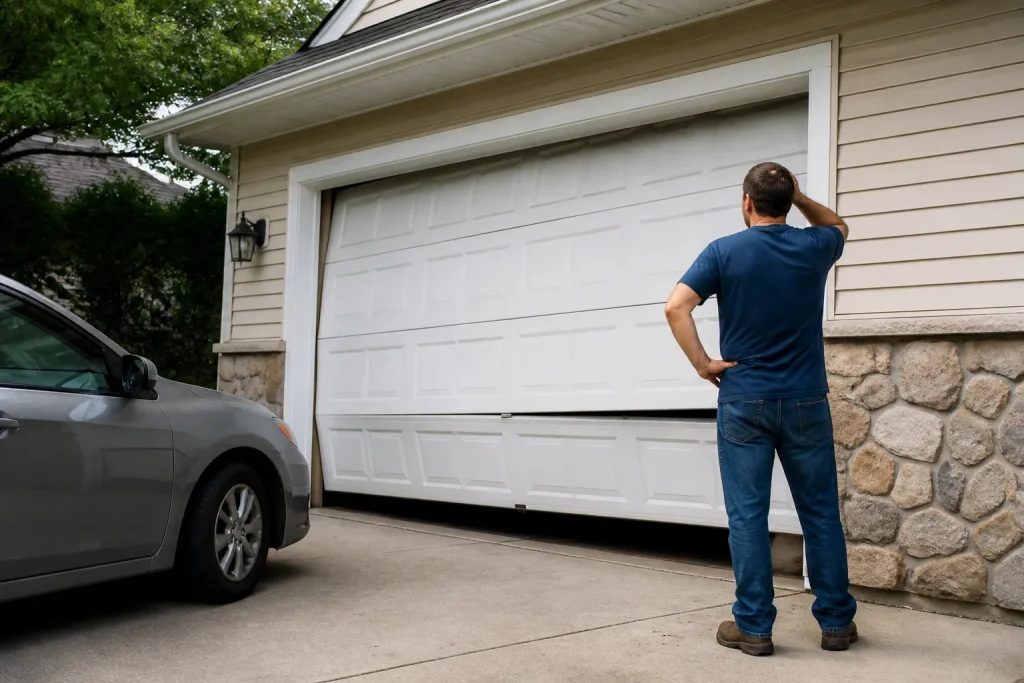
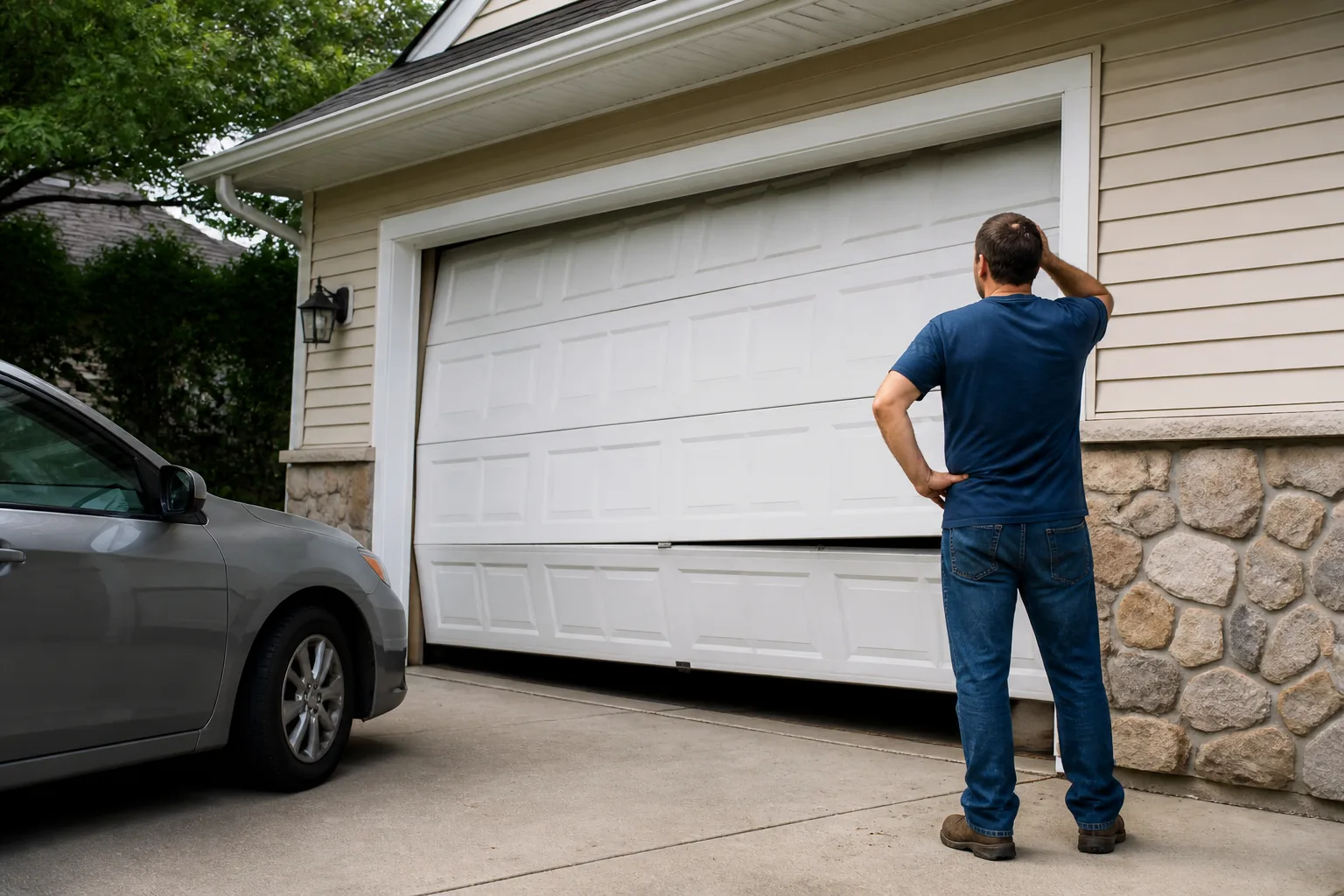
- Visibly uneven, crooked, or hanging off one side
- Stuck open with a car trapped inside, or stuck closed with the house unsecured
- Showing a gap in a spring or a frayed cable
- Reversing inconsistently and getting worse
Our technicians have up to 9 years of experience, and we work on LiftMaster, Chamberlain, Genie, Clopay, Amarr, Wayne Dalton, Craftsman, and Raynor equipment. Emergency garage door service is part of what we do, not an upgrade. It’s the right part for your specific system, not a generic replacement that half-fits. And it’s emergency service, not emergency pricing.
Related services in Burnsville: if your door needs a repair, our garage door repair team can help; if the opener is the problem, try garage door opener repair. For the full picture of what we do, visit Burnsville Garage Door Repair Co.
The Bottom Line
None of the signs above are subtle. They’re just easy to talk yourself out of because the door still works. Grinding, popping, and squealing each point to specific parts, and they don’t improve on their own. Slow operation is one of the most reliable early warnings you’ll get, and it’s all but invisible unless you’re paying attention to your door’s normal timing. A door that reverses unexpectedly is often out of balance, and that’s a strain on the whole system, not just the sensors. And the winter symptoms Burnsville homeowners blame on the cold are usually maintenance problems that a seasonal tune-up would have caught.
The pattern across all of them is the same: the repair is cheaper when it’s small. A spring that gets looked at when it first goes soft costs less than a spring plus an opener plus a bent track. If you’ve read this far and something sounded familiar, the free estimate is the cheapest part of the whole thing.
If you’re in Burnsville and need help, Burnsville Garage Door Repair Co offers free estimates. Nothing gets started until you’ve agreed to a written price, so there’s no surprise on the invoice. Call (855) 560-7429 and we’ll get your door back on track today.
Frequently Asked Questions
The earliest sign is usually a change in sound or speed, not something you can see. A door that grinds, pops, squeals, or takes a few seconds longer to open than it used to is already telling you a part is failing. Visible signs like a frayed cable or a gap in a spring come later, and by then the problem is usually more serious. If you’re in Burnsville and notice any of these, call (855) 560-7429 for a free estimate.
No. Springs are the most dangerous component in your garage door system and hold hundreds of pounds of tension. A spring that breaks during a DIY repair can cause serious injury. This is a job for a trained technician, and it’s one of our core specialties. Call (855) 560-7429 and we’ll take a look.
A door that reverses near the floor is often out of balance, not a sensor problem. When the opener feels resistance it can’t overcome, it reverses as a safety measure, and that resistance is usually a spring that’s lost tension. Dirty or misaligned sensors can cause the same symptom, but if the reversal is inconsistent, balance is the likely cause. Call (855) 560-7429 for a free estimate and we’ll test it properly.
If the door is noisy, slow, uneven, or reversing, yes. A door that still moves with a failing spring or cable is putting strain on the opener and the track, and the repair is cheaper now than it will be after something else breaks. We give free estimates, so it costs nothing to find out whether you’re looking at a minor adjustment or something bigger. Call (855) 560-7429.
Written by the team at Burnsville Garage Door Repair Co.
Need Garage Door Help?
Call Burnsville Garage Door Repair Co - the local pro we connect you with is licensed and insured, here with fast after-hours help in Burnsville.
(855) 560-7429